page-header
Our case studies

From Craft to Sustainable Livelihoods: Agra Embroidery Cluster

Perfect way to Showcase Your Work

Asma
Leadership

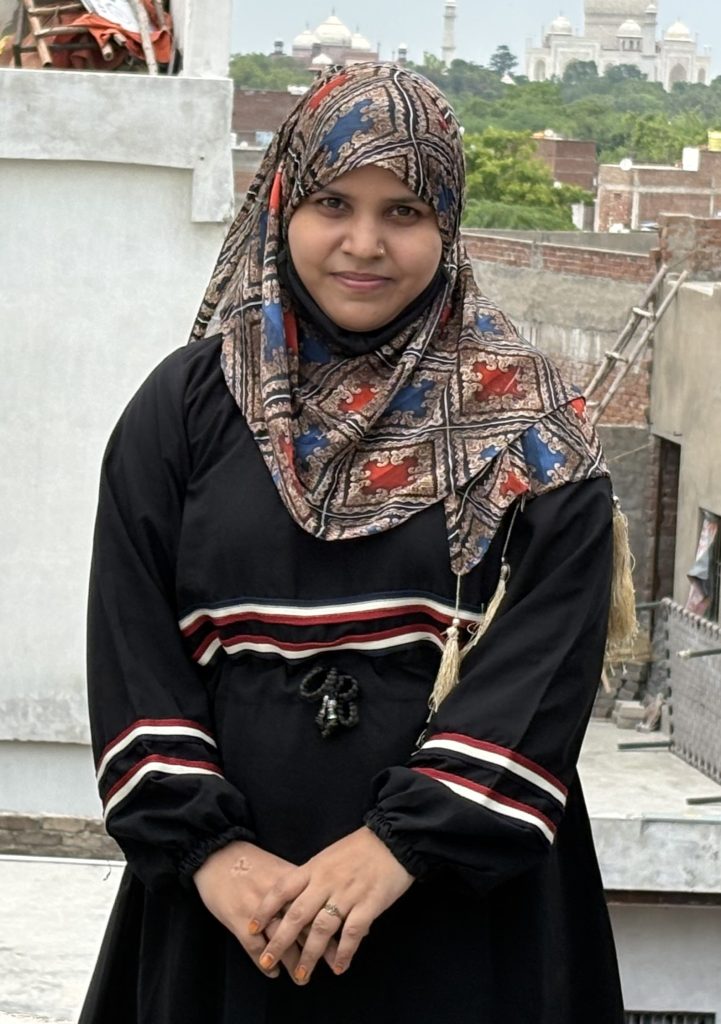
Step into Asma’s home, and you feel it instantly: warmth, order, and a quiet sense of peace. Every corner is nicely decorated, carrying the same care that Asma puts into her craft. Her home stands close to the Taj Mahal, and every morning, as the sun rises over the monument, its first golden rays travel across the rooftop and land gently on her wrist, as if the beauty of the Taj itself had come to rest there. But Asma’s real story lies in her hands, hands that have spent years perfecting the delicate art of zardozi embroidery. There was a time when Asma didn’t earn at all. When she started working, her income was barely ₹2,000 to 3,000 a month, never quite enough.

Everything changed with training. Her skills sharpened, her craftsmanship improved, and soon she began attending exhibitions, where her work found the recognition it deserved. More exposure brought more work, and more work brought something she had never known before: financial stability. For the first time, she could save a little during festivals, and happiness slowly found its way into her home. The proudest moment of her journey came when her daughter got married. Asma didn’t have to ask anyone for money. She paid for the wedding with her own earnings, and even sent her daughter off with generous gifts for her new family. There was no need to stretch her hand in front of anyone, only pride in what she had built for herself.
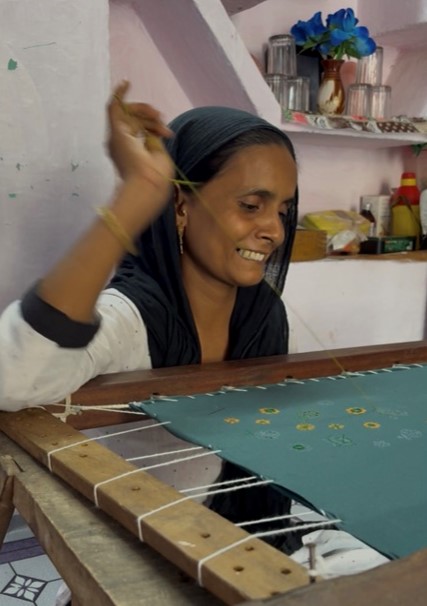
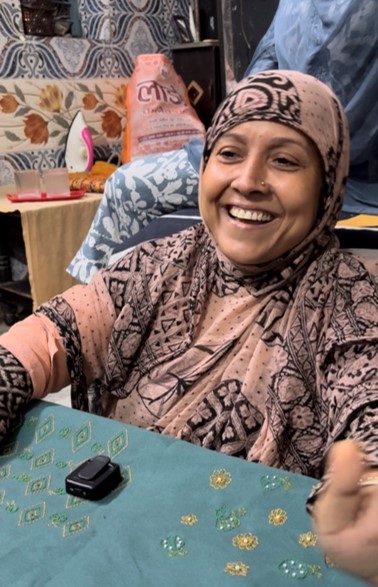
Today, Asma’s work has earned her something money alone cannot buy: respect. At home, no decision is made without her opinion. And when work keeps her busy, her family steps in without being asked, cooking meals, looking after the children, sending them to school, so that her craft never has to wait. Asma smiles more now. Because ever since she picked up this work, she hasn’t just been earning a living, she’s been living with dignity.

Imrana
Confidence

Long before Imrana ever earned a single rupee from it, embroidery was already a part of her, passed down not in a classroom, but at her mother’s side, stitch by stitch, at home. That inheritance is what makes the craft so dear to her; it isn’t just work, it’s family. Today, she earns ₹500 to 1,000 a day for her embroidery. But it wasn’t always this way. Before her training, Imrana knew only one kind of work, one technique, one path. She would sit from morning till evening, and at the end of it all, earn barely ₹100 for a full day’s labour.

Training changed everything. What she once did by rote, she now does with mastery, she creates finished pieces from scratch, sketches her own designs, matches colours with a trained eye, and builds patterns that are entirely her own. Government schemes that once felt out of reach became accessible too; she now holds an Aabha card and a Shilpi card, documents she never had before, opening doors that were once closed to her. Her earnings tell the real story: from ₹50 to 100 a day to rates she now negotiates herself, rates she feels are fair. She says it feels like her income has grown tenfold, but more than the money, it’s the choice that matters, the ability to say what her work is worth.

There was a time when contractors would take her work, promise ₹4,000 to 5,000, and vanish without paying, because, as she puts it, women are expected to work for free. That has changed too. Through her training, she found her way to people she could trust, and today, her payments come straight to her bank account, no cash changing hands, no middlemen skimming what’s rightfully hers. And when that payment lands, it means something different to Imrana than any other money ever has. It isn’t her husband’s income, or her mother’s, it’s hers, earned by her own hands. She no longer has to ask anyone for money when she needs it; she simply pays for it herself. That, she says, is what makes her feel strong.

Sazia
Key Stakeholder

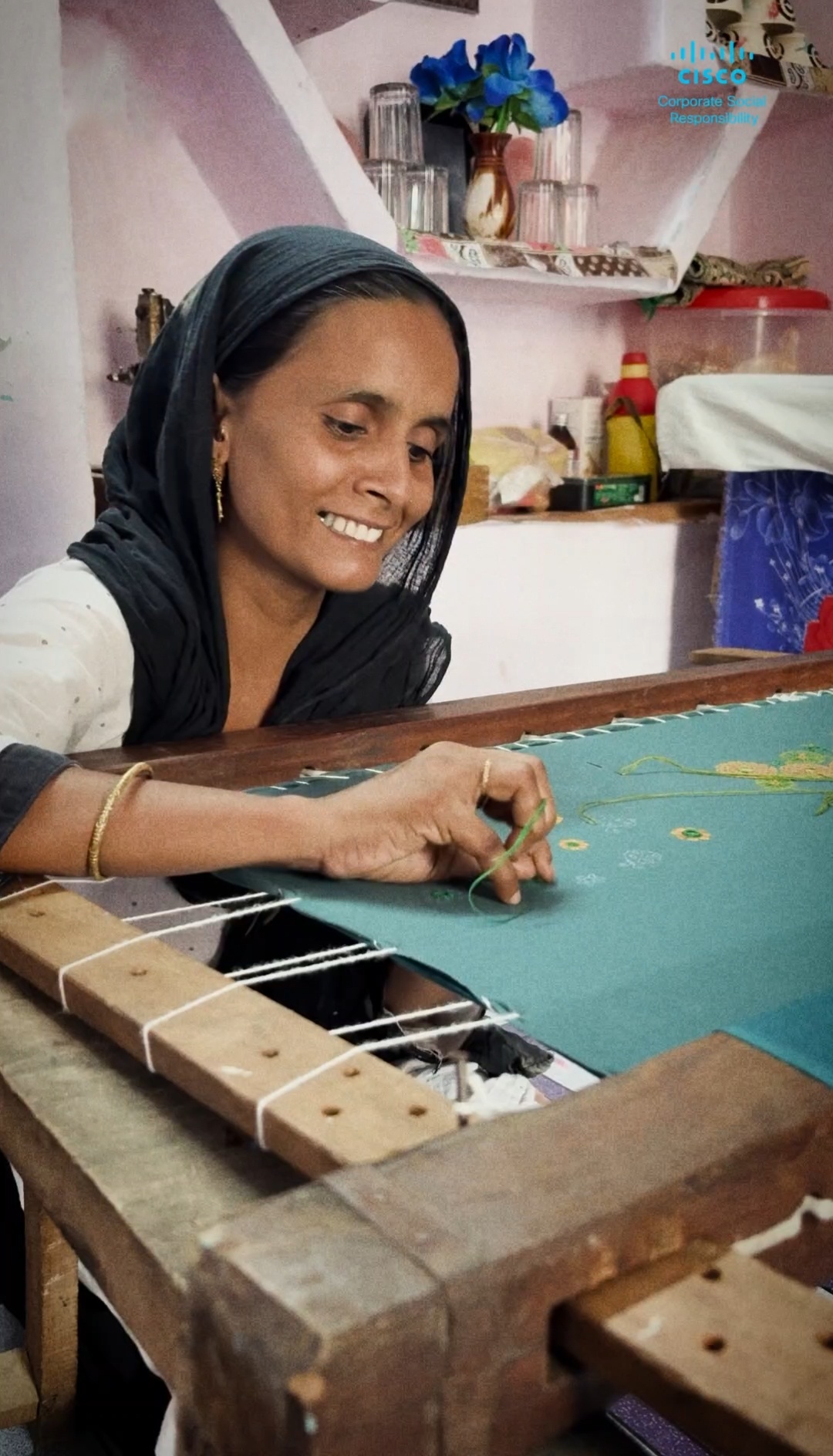
Near the Taj Mahal, in a small but beautiful home, Sazia sits with her husband, kind, supportive, always by her side, and creates embroidery that carries a decade of skill in every stitch. With ten years of experience behind her, she was once limited to making just one kind of piece. But training changed the shape of her craft entirely. Today, Sazia builds finished products from scratch, working across fabrics she never touched before, synthetic, leather, cloth, rexine, turning each into something worth framing and selling.

In just one year, she has been part of countless exhibitions, and through them, found connections that keep her hands constantly busy; work, she says, is something she no longer has to search for. She sits facing the Taj Mahal itself and stitches its likeness into her frames, alongside peacocks and other intricate designs that have become her signature. Her repertoire has grown far beyond embroidery pieces alone, she now creates handbags and jewellery boxes, each finished with a precision that matches the hands of a true expert.

For Sazia, this journey has been about more than skill, it has given her something she always wanted: her own identity, built entirely through her work. Her finishing, she says, is now the kind you’d expect from a specialist, because through training and years of practice, that is exactly what she has become.

Monika
Creativity

In Vrindavan, where nearly every home welcomes a Laddu Gopal into their family, treating the deity with the same love and care as a child, Monika Shukla found her calling in dressing him. Families here don’t just keep Laddu Gopal, they dress him for every season, warm clothes in winter, soft cotton and light fabrics in summer, inspired by the traditions of the famous Banke Bihari temple that draws devotees from across the country and beyond. And wherever devotion goes, so does demand, visitors from India and abroad don’t just come for darshan, they carry home vastra for their own Laddu Gopal too. Nowhere does that demand peak more than on Janmashtami, when heavy, celebratory outfits are commissioned in bulk to mark his birth, flooding the markets of Mathura and Vrindavan with orders.

Before her training, Monika could only create basic, plain designs, work that limited both her creativity and her earnings. Training changed that entirely. She learned to draw and design with far greater skill, eventually mastering intricate patterns like peacock motifs, among the most sought-after designs in the market, work that commands a noticeably better price. Her training didn’t stop at craft alone; it opened her eyes to government schemes she never knew existed. Through it, she learned about the Yuva Udyami Loan Yojana, applied, and secured funding that let her expand her business beyond what she’d imagined possible.

The results speak for themselves. Monika’s profits have grown significantly, but perhaps more remarkable is what she’s built around her: a workshop of her own, employing 15 women who now earn wages through her business. What began as one woman’s craft has become a livelihood for many, proof that when skill meets opportunity, it doesn’t just change one life, it lifts an entire circle of women alongside it.

Back to top of page